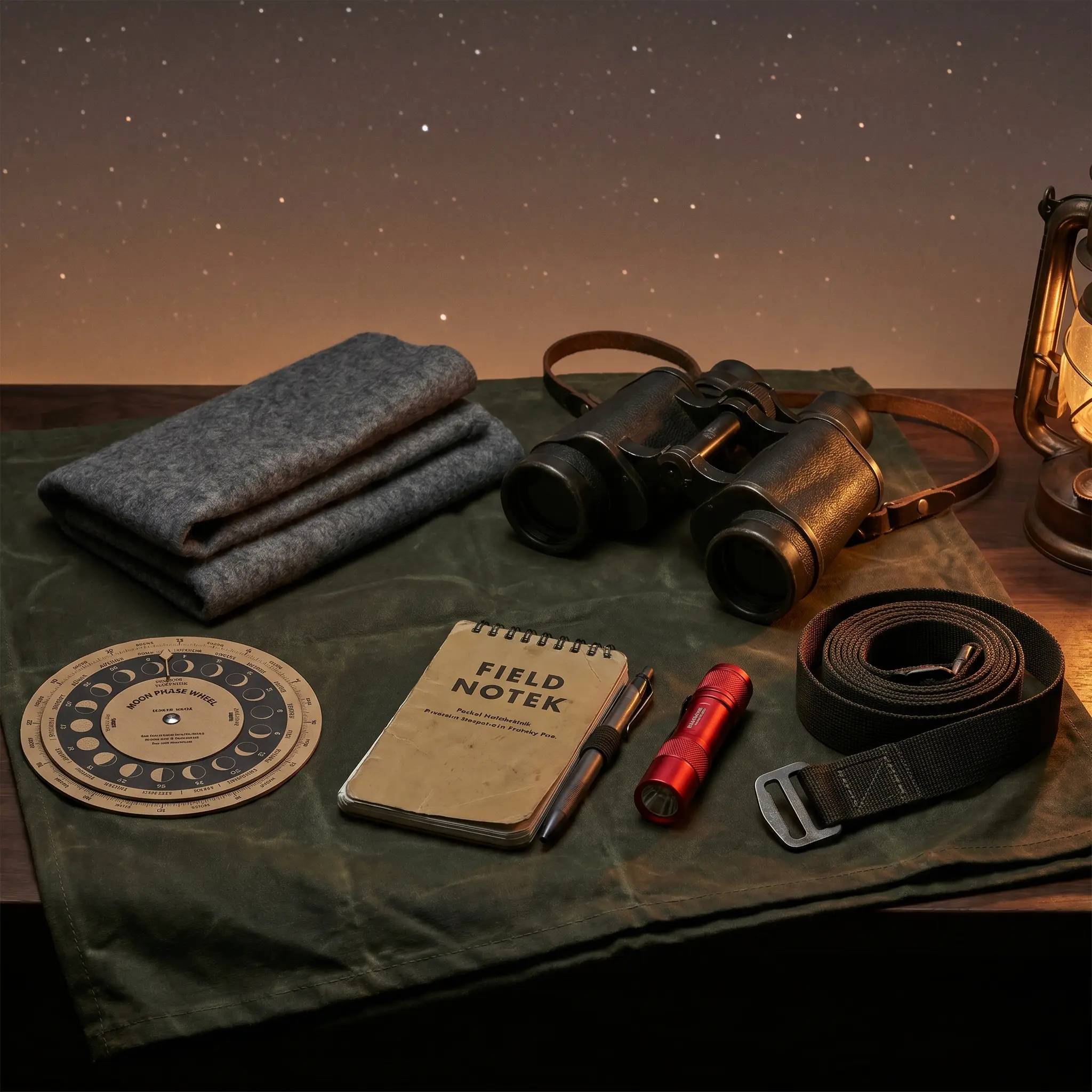
Before you leave
A good comet watch starts with a route, not a telescope.
Begin with the comet's altitude at the time you can actually observe. A chart that looks generous at midnight may be useless if the object is sinking behind buildings at dusk. Check the direction with a compass app while standing at your site, then decide whether the horizon is clean enough for a diffuse object. A single roofline or tree row can remove the best twenty minutes.
Pack for stillness. Binoculars, a small scope, a red light, a chair, a printed finder, a pencil, and one warm layer are often more valuable than extra electronics. If moonlight is present, aim for the darkest interval and turn your body away from nearby glare. If the comet is expected to be faint, prepare comparison targets such as a globular cluster or galaxy with known difficulty.
Field order
- Arrive early enough to inspect the horizon in remaining twilight.
- Use binoculars first, then a telescope only after the star field is confirmed.
- Record a confidence level before looking at recent photographs or reports.
- End with one sentence about the sky itself: haze, wind, dew, glare, and comfort.